
Evaluate the Trinity College Dublin Clean Air Living Lab for Urban Air Quality Monitoring
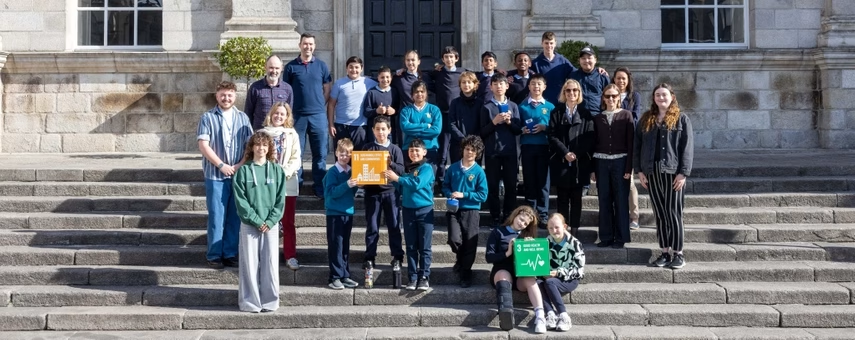
Addressing urban air pollution requires accurate data, community engagement, and applied research. In Ireland, the push for cleaner urban environments has led to innovative collaborations between higher education institutions and local communities. A prime example of this approach is the recent Clean Air Living Lab project spearheaded by Trinity College Dublin. This initiative not only provides critical data on local pollution levels but also serves as a practical framework for sustainability education, demonstrating how academic research can directly inform public health and urban planning decisions.
Understanding the Clean Air Living Lab Concept in Ireland
A “living lab” is a research concept that integrates real-world settings into the scientific process, moving data collection out of isolated laboratories and into the community. The Clean Air Living Lab initiated by Trinity College Dublin was launched during Green Schools Ireland CleanAir Week to engage students, staff, and the wider Dublin community in understanding local air quality. Rather than relying solely on remote monitoring stations, this project placed monitoring equipment directly across the College Green campus and at a nearby primary school to capture highly localized data.
In Ireland, the most pressing air quality concerns center around two primary pollutants: fine particulate matter (largely generated by solid fuel burning) and nitrogen dioxide (NO₂). Nitrogen dioxide is particularly relevant in urban centers like Dublin because it is closely linked to traffic congestion and combustion sources. The Environmental Protection Agency (EPA) warns that even short-term exposure to NO₂ can cause immediate respiratory harm. Long-term exposure carries more severe consequences, significantly increasing the risk of respiratory diseases, cardiovascular disease, stroke, and lung cancer. These stark health implications underline the necessity for hyper-local air quality monitoring and immediate action to improve urban air quality.
Measuring Urban Air Quality: Methodology and Technology
To accurately assess the air quality across its campus and the surrounding Dublin 8 area, the project relied on a specific, accessible technology over a defined six-month period. By establishing 22 distinct monitoring locations, researchers could gather a nuanced dataset that reflected the varying environmental conditions present in a busy urban setting.
Utilizing Nitrogen Oxide Diffusion Tubes
The primary tool used in this living lab was the Nitrogen Oxide (NOx) diffusion tube. These tubes are a cost-effective, widely recognized method for monitoring ambient NO₂ levels over extended periods. Unlike complex, automated monitoring stations that require significant power and maintenance, diffusion tubes passively absorb nitrogen dioxide from the surrounding air. This simplicity allows researchers to deploy a large number of tubes simultaneously across diverse locations without disturbing the daily activities of the campus or the community.
For the purposes of sustainability education, NOx tubes are highly effective. They provide a tangible, physical representation of an invisible environmental threat. When students and community members can see the tubes installed in their familiar environments, the abstract concept of air pollution becomes concrete and measurable.
Key Findings from the Trinity College Dublin Campus
The data collected from the 22 locations revealed significant, localized variations in nitrogen dioxide concentrations across the Trinity College Dublin campus. These findings highlight the fact that air quality is not uniform across a city or even a single neighborhood; it fluctuates dramatically based on immediate surroundings.
The Impact of Traffic Proximity on NO₂ Concentrations
The highest average concentration of NO₂ recorded during the project was found directly below the bridge at Pearse Station. This location is characterized by heavy, concentrated vehicular traffic, restricted airflow, and constant combustion emissions from buses and cars. Conversely, the lowest concentration was measured at the Hamilton Building, a location situated further away from the immediate choke points of traffic.
The stark contrast between these two locations—despite their relative proximity to one another—demonstrates how micro-environments function within a city. It proves that air quality can significantly differ over distances as short as a few hundred meters. This micro-level data is invaluable for urban planners and facility managers, as it identifies specific hotspots that require targeted interventions rather than broad, unfocused policies.
Integrating Sustainability Education with Local Communities
A defining feature of the Clean Air Living Lab is its emphasis on community partnership and education. Scientific data is only as useful as the actions it inspires, and those actions require public understanding and support.
Partnering with South City Community National School
Trinity College Dublin partnered with South City Community National School to bring the living lab directly into the curriculum. Primary school students visited the university campus to participate in a knowledge exchange session with Trinity Sustainability, An Taisce, Professor John Gallagher, and postgraduate students. During this session, the primary students learned exactly how NOx tubes function, how they are deployed to measure air quality, and what the specific data points collected during the project actually mean.
This type of sustainability education goes beyond textbook learning. It introduces young students to scientific methodology, data collection, and environmental stewardship in a real-world context. The students also engaged in discussions about actionable steps to improve air quality, concluding their visit with a biodiversity tour led by the Biodiversity Officer. By connecting air quality with broader ecological health, the project helps students understand the interconnected nature of urban environments.
Strategic Plans for Improving Air Quality in Dublin
Collecting data is only the first phase of a living lab; the subsequent phase involves using that data to drive operational and structural changes. Trinity College Dublin has utilized the findings from the Clean Air Living Lab to inform concrete strategies aimed at reducing its own environmental footprint and improving the local environment.
The Campus Travel Plan and Biodiversity Plan
To address the traffic-related NO₂ concentrations identified in the study, Trinity published a comprehensive Campus Travel Plan and a Biodiversity Plan. These strategic documents outline specific actions designed to mitigate air pollution on campus. Key measures include reducing the frequency of delivery vehicles entering the campus, actively discouraging car travel to the university by promoting alternative transit, and reallocating physical space to prioritize pedestrians and nature over vehicles. As noted by the academic lead on the project, Professor John Gallagher, the data allows the university to better protect staff, students, and visitors while maximizing outdoor campus spaces for teaching outside the traditional classroom.
The Green Pearse Street Initiative
Recognizing that air quality does not stop at the campus boundaries, Trinity College Dublin is also a key participant in the Green Pearse Street initiative. This collaborative effort works directly with local businesses to enhance cycling infrastructure and expand green spaces in the surrounding Dublin 8 area. By improving active travel routes and increasing vegetation—which naturally filters pollutants—the initiative aims to reduce vehicle emissions and improve the overall air quality of the wider neighborhood.
Thinking About Studying at Trinity College Dublin?
Fill out the form to receive personalized guidance from a Studygram expert counselor. You’ll get support with choosing the right program, understanding admission requirements, preparing documents, and completing the application process smoothly. Start your journey at Trinity College Dublin with confidence and expert support.