Examine How TU Dublin Researchers Drive Artificial Intelligence, Healthcare Innovation, and Energy Decarbonisation in Ireland
Understand the Research Ireland Rinn Network Investment
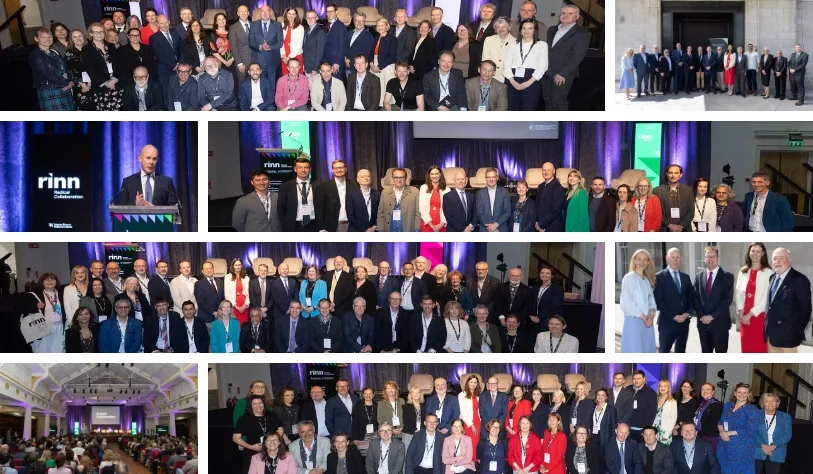
Keeping up with the latest news articles regarding national funding reveals a major shift in how Ireland approaches complex global challenges. The Irish government recently announced a substantial €460 million investment into the country’s research and innovation ecosystem through the new Research Ireland Rinn network. This funding establishes seven new national research centres, uniting 17 research-performing organizations, industry partners, and public sector bodies. Representing one of the most significant investments in research and innovation ever made in Ireland, the Rinn network focuses on turning excellent, multidisciplinary research into tangible societal and economic impact.
Minister Lawless highlighted that the scale of this investment serves as a powerful statement of Ireland’s ambition. Over the past 13 years, Research Ireland centres have fundamentally reshaped the national innovation landscape. Building on that progress, the new Rinn network supports talent development, strengthens industry partnerships, attracts foreign direct investment, and promotes regional development. Dr Diarmuid O’Brien, CEO of Research Ireland, emphasized that the network relies on radical collaboration and deep connectivity at scale to reinforce Ireland’s international standing.
Within this massive national initiative, TU Dublin researchers play a highly prominent role. Technological University Dublin is contributing directly to four of the seven new centres, specifically targeting artificial intelligence, healthcare innovation, and energy decarbonisation. For prospective researchers, students, and industry professionals, understanding TU Dublin’s involvement in the Rinn network provides clear insight into where future career opportunities and technological advancements will originate.
Schedule a free consultation to learn more about TU Dublin’s programmes.
Advance Artificial Intelligence and Data Science in Ireland
Addressing the rapid evolution of machine learning and automation requires dedicated, large-scale infrastructure. The Rinn Artificial Intelligence centre operates as a €121.8 million national initiative designed to serve as the central hub for cutting-edge research in data science and artificial intelligence in Ireland. Rather than solely focusing on theoretical concepts, this centre prioritizes both foundational AI research and the practical application of emerging technologies to solve real-world societal challenges.
TU Dublin’s involvement in this centre is led by Dr Dympna O’Sullivan, Vice President for Research and Innovation, and Dr Robert Ross, Senior Lecturer in the School of Computer Science. Both serve as Co-Applicants for the centre, helping to guide the strategic direction of AI research on a national level. Their work ensures that TU Dublin remains at the forefront of responsible AI development, a critical consideration as governments and industries worldwide grapple with the ethical, social, and economic implications of automated systems.
The scope of the Rinn Artificial Intelligence centre extends across multiple sectors. Researchers are investigating how AI can improve healthcare delivery, optimize public services, enhance governance structures, and enrich cultural preservation. By treating artificial intelligence not just as a technological tool but as a broad societal force, the centre aims to develop systems that are transparent, fair, and aligned with public interest. For tech professionals and students, this centre represents a primary pipeline for acquiring advanced skills in AI ethics, machine learning architecture, and data engineering.
Accelerate Healthcare Innovation Through Advanced Therapies and Medical Devices
Improving patient outcomes demands continuous healthcare innovation. The Rinn network dedicates significant resources to two distinct but complementary medical research centres: Rinn Advanced Therapies and Rinn Medical Devices. TU Dublin researchers hold critical leadership and principal investigator roles in both, bridging the gap between laboratory discoveries and clinical applications.
Dr Elaine Harris, a Lecturer in Pharmaceutical Sciences at TU Dublin’s School of Chemical and BioPharmaceutical Sciences, serves as a co-lead for the Regulate theme within Rinn Advanced Therapies. This centre focuses heavily on personalized advanced cellular immune therapeutics. By tailoring medical treatments to the individual immune profiles of patients, researchers are developing highly targeted responses to complex diseases. This approach holds particular promise for treating cancers and severe chronic diseases that do not respond well to traditional, one-size-fits-all therapies.
Simultaneously, Dr Harris acts as a Principal Investigator for Rinn Medical Devices. This centre concentrates on designing, testing, and commercializing next-generation medical devices. From diagnostic tools to implantable technologies, the medical devices centre addresses the practical engineering and material science challenges inherent in modern medicine. Together, these two healthcare centres directly tackle the pressing needs of an ageing population, working to reduce the burden on acute care facilities while improving the quality of life for patients dealing with long-term health conditions.
Target Chronic Disease and Healthy Ageing
Focusing specifically on demographic shifts, the healthcare innovation centres within the Rinn network prioritize healthy ageing. As life expectancy increases globally, healthcare systems face unprecedented pressure from age-related illnesses and chronic disease management. The research led by TU Dublin academics investigates cellular repair mechanisms, advanced drug delivery systems, and non-invasive monitoring devices. These technologies enable earlier interventions, reducing the need for expensive surgical procedures and lengthy hospital stays. By combining advanced therapies with innovative medical devices, the Irish research ecosystem is building a comprehensive, multi-layered approach to modern healthcare challenges.
Support Energy Decarbonisation for a Net-Zero Economy
Achieving climate goals requires aggressive energy decarbonisation. The Rinn Energy centre represents a €51.8 million investment dedicated entirely to research and innovation in energy system decarbonisation. Ireland faces unique energy challenges due to its geographic position, reliance on imported fossil fuels, and rapidly growing electricity demand driven by data center expansion and electrification of heat and transport.
Dr Ciara Ahern, a Senior Lecturer in TU Dublin’s Faculty of Engineering and Built Environment, acts as a Co-Applicant for the Rinn Energy centre. Under her contribution and the broader consortium’s guidance, the centre brings together expertise from across science, engineering, economics, and policy. This multidisciplinary approach is strictly necessary because transitioning to a sustainable energy future is not solely a technical engineering problem; it requires viable economic models and supportive regulatory frameworks.
The Rinn Energy centre focuses on several critical technical pathways. Researchers are tackling renewable energy integration, determining how to stabilize the grid when relying on intermittent power sources like wind and solar. Smart grid technologies form a major component of this work, utilizing artificial intelligence and data science to predict demand and dynamically route power. Additionally, the centre investigates offshore energy systems, capitalizing on Ireland’s vast Atlantic marine renewable resources, and industrial decarbonisation, which involves helping heavy industries reduce their carbon emissions through electrification, carbon capture, and alternative fuels.
Build Talent and Industry Partnerships for Future Prosperity
Connecting academic research with commercial application remains a primary objective of the Rinn network. Dr Dympna O’Sullivan notes that the challenges facing society today do not fit neatly within traditional disciplinary boundaries. Resolving issues related to climate change, complex diseases, and automated decision-making requires collaboration at an unprecedented scale. The Rinn centres facilitate this by formally structuring partnerships between higher education institutions, multinational corporations, indigenous Irish enterprises, and government agencies.
For students and early-career researchers, this structured collaboration translates into direct exposure to industry workflows and commercial realities. Dozens of TU Dublin researchers will work alongside leading academics both in Ireland and internationally. They will engage in enterprise engagement activities designed to translate academic findings into market-ready products and services. This environment actively cultivates a highly skilled workforce proficient in both theoretical research and practical implementation.
Furthermore, the presence of these national centres strengthens Ireland’s value proposition for foreign direct investment. Multinational technology, pharmaceutical, and energy companies frequently base their European operations in locations with strong, accessible research ecosystems. By housing four of the seven Rinn centres, TU Dublin significantly boosts the regional and national capacity to attract high-value investments, creating a positive feedback loop of funding, research, and job creation.
Navigate the Future of Research and Innovation in Ireland
Analyzing the scope of the €460 million Rinn network makes it clear that Ireland is positioning itself as a global leader in critical technologies. TU Dublin researchers are not merely participating in this initiative; they are actively shaping the strategic direction of artificial intelligence, healthcare innovation, and energy decarbonisation. The work being initiated in the summer of 2026 will define the country’s economic resilience, public health outcomes, and environmental sustainability for decades to come.
Whether you are a prospective student seeking a university deeply integrated into national research priorities, an industry professional looking for collaborative R&D partners, or a policymaker tracking innovation trends, TU Dublin’s central role in the Rinn network offers a clear point of engagement. The university’s commitment to applied research ensures that academic advancements consistently move toward practical, real-world deployment.
Take the Next Step
Ready to start your studies at TU Dublin? Our expert advisors are here to guide you through every step — from choosing the right program that matches your goals to supporting you through the application process and preparing for student life in Ireland.
Fill out the form today to schedule your FREE consultation with one of our study abroad experts and take the next step toward your future with confidence.