
Examine Trinity College Dublin and the Education Investment Demands for Ireland’s Budget 2027
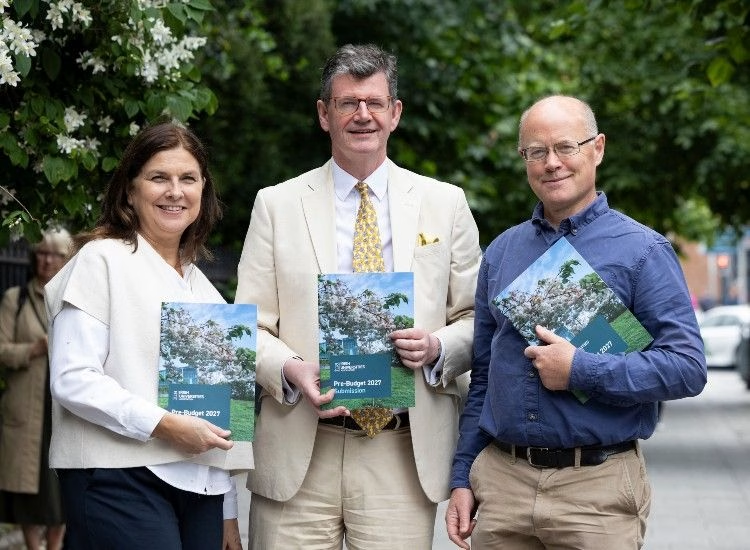
As Ireland approaches the formulation of its national finances for the coming year, the higher education sector finds itself at a critical crossroads. The Irish Universities Association (IUA), representing seven research-intensive institutions including Trinity College Dublin, has presented a comprehensive pre-budget submission outlining urgent financial requirements. Understanding the specifics of this request provides valuable context for prospective students, policymakers, and professionals tracking the economic landscape of Ireland. Budget 2027 represents a pivotal opportunity to address systemic financial shortfalls and secure the future of the country’s knowledge economy.
Understanding the Persistent Higher Education Funding Gap in Ireland
Discussions regarding public university funding in Ireland are not new, but the metrics surrounding the current deficit demand immediate attention. In 2022, the Irish government formally acknowledged that the higher education sector was operating with an annual shortfall exceeding €300 million. This was not a disputed figure but a mutually recognized baseline indicating systemic underinvestment.
Four years later, despite significant increases in public spending across various other governmental departments, the structural deficit in higher education remains a formidable challenge. According to recent assessments, €133.5 million of that original annual deficit persists. This remaining funding gap is not a static number; it is actively compounded by unavoidable cost increases, including rising pay awards for faculty and staff, as well as mounting pressures from expanding student numbers driven by demographic growth.
The Numbers Behind the Deficit
To put this into perspective, Ireland maintains one of the highest proportions of third-level educated citizens in the global landscape. Sustaining this rank requires infrastructure, staffing, and resources that scale with student demand. When funding fails to keep pace with enrollment numbers, the quality of the student experience, the student-to-staff ratio, and the capacity for cutting-edge research are all placed under direct strain. For an institution like Trinity College Dublin, which competes on a global stage for both students and academic talent, eroding financial support threatens its competitive standing and operational effectiveness.
Core Financial Requests for Budget 2027
To address these compounding challenges, the IUA has structured a targeted, multi-faceted request for Budget 2027. The submission focuses on four distinct areas of education investment, each designed to stabilize the sector and align it with future economic realities.
Expanding Academic Capacity with Core Grants
The primary request is an annual increase of €190 million in core grant funding. This allocation is specifically aimed at tackling historical under-investment and meeting the unavoidable cost increases projected for 2027. The direct impact of this funding would be the creation and retention of approximately 550 academic posts across the university network.
Increasing the number of academic staff has an immediate and measurable effect on the quality of education. Smaller class sizes, increased availability of faculty for mentorship, and a reduced reliance on adjunct or temporary teaching contracts all contribute to a more stable, high-quality learning environment. For students attending Trinity College Dublin, this translates directly into enhanced teaching quality and better academic support.
Modernizing Digital Infrastructure for AI and Research
The second major request involves €250 million allocated over five years specifically for capital spending on digital infrastructure. As global industries integrate artificial intelligence, advanced data analytics, and machine learning into their core operations, universities must provide teaching and research environments that reflect these technological shifts.
Upgrading digital infrastructure means more than just faster campus Wi-Fi. It involves high-performance computing clusters, advanced data storage capabilities, specialized software licenses, and smart campus technologies that facilitate modern research methodologies. For Ireland to maintain its attractive position for multinational technology corporations, graduates must be trained using current, industry-standard tools. Ensuring that institutions like Trinity College Dublin have the hardware and digital architecture to teach AI effectively is a fundamental economic necessity.
Decarbonizing the University Estate
Aligning with national climate commitments, the IUA has requested €475 million over four years dedicated to the decarbonization of university campuses. Ireland’s Climate Action Plan sets aggressive targets for reducing carbon emissions across all public sectors. Universities, many of which operate out of aging, energy-inefficient historical buildings, face significant capital hurdles in meeting these mandates.
For Trinity College Dublin, which manages a vast estate in the heart of Dublin city center, decarbonization involves complex retrofitting projects, upgrading heating systems, improving insulation, and integrating renewable energy sources. This education investment not only ensures compliance with national law but also serves as a living laboratory for students studying sustainability, environmental science, and engineering.
The Role of the National Training Fund in Lifelong Learning
Perhaps the most strategic request in the pre-budget submission involves the National Training Fund (NTF). Currently, the NTF holds nearly €2 billion. The IUA, alongside major business lobby groups such as IBEC and ISME, is calling for this fund to be accessed to facilitate lifelong learning, upskilling, and reskilling programs at the university level.
The traditional model of a university student—entering at age 18 and completing a degree by age 22—no longer represents the entirety of the higher education ecosystem. Technological disruption and geopolitical shifts mean that professionals must continually adapt their skill sets throughout their careers. By directing NTF resources toward universities, the government can create structured, academically rigorous pathways for adults to return to education. This relieves the pressure on the core grant funding, which is primarily designed for traditional undergraduate pathways, and creates a dedicated revenue stream for continuing education.
Why Higher Education Investment Matters for Ireland’s Economy
Paul Johnston, Director General of the IUA, articulated a straightforward reality in the recent pre-budget briefing: Ireland’s only natural resource is its people. Unlike countries with vast mineral wealth, large-scale manufacturing bases, or significant agricultural exports, Ireland’s economic model is entirely dependent on a highly educated, adaptable workforce.
The presence of major global technology, pharmaceutical, and financial services firms in Ireland is directly correlated to the quality of the local talent pool. These companies locate their European headquarters in Dublin and elsewhere in Ireland specifically because they can recruit highly skilled graduates. If the funding gap forces universities to reduce research output, increase class sizes, or delay technological upgrades, the quality of the graduate pool diminishes. Over time, this makes Ireland a less attractive destination for foreign direct investment.
Furthermore, universities act as incubators for indigenous enterprise. Research spin-outs, innovation hubs, and technology transfer offices rely on the underlying health of the academic institution. When core funding is cut or stagnates, these ancillary economic activities—the very activities that create new jobs and new industries—are the first to suffer.
What Budget 2027 Means for Prospective Students
For prospective students evaluating their options, the outcomes of Budget 2027 will have tangible effects on their university experience. A positive budget outcome that addresses the funding gap means better facilities, more accessible faculty, and access to cutting-edge research tools. Conversely, a failure to address the deficit could result in increased strain on existing resources, potentially leading to larger lecture halls and fewer elective options.
Trinity College Dublin remains committed to delivering world-class education regardless of the political climate, but the institution’s capacity to grow and adapt is inherently tied to state support. The decisions made in Budget 2027 regarding education investment will determine whether Irish universities can merely maintain their current standing or actively advance their global competitiveness.
The higher education sector has articulated its needs clearly. The data supporting the funding gap is well-documented, and the proposed solutions align directly with national economic and environmental goals. As the budget date approaches, the focus now shifts to the government to determine the priority placed on Ireland’s long-term intellectual infrastructure.
Take the Next Step
Ready to start your studies at Trinity College Dublin? Our expert advisors are here to guide you through every step — from choosing the right program that matches your goals to supporting you through the application process and preparing for student life in Ireland.
Fill out the form today to schedule your FREE consultation with one of our study abroad experts and take the next step toward your future with confidence.