Examine TU Dublin’s Role in Ireland’s €37.5 Million Agri-Food Research and Bioeconomy Investment
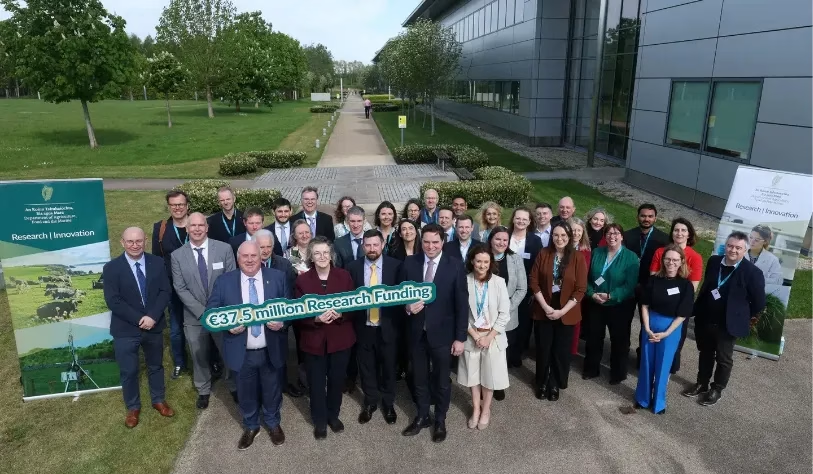
Understanding the €37.5 Million National Investment in Ireland’s Bioeconomy
The Department of Agriculture, Food and the Marine (DAFM) recently announced a substantial €37.5 million national investment aimed at advancing agri-food research, forestry, and the bioeconomy. Distributed through the DAFM 2025 Thematic Research Call, this funding supports 30 research projects across Ireland and Northern Ireland. Among the leading institutions selected to drive this initiative forward, Technological University Dublin (TU Dublin) has secured funding for six major research projects.
This targeted financial support is designed to address pressing challenges within the agricultural and food sectors. By prioritizing climate mitigation, biodiversity, sustainable food production, and bioeconomy innovation, the national programme directly contributes to the strategic goals outlined in Food Vision 2030 and Impact 2030: Ireland’s Research and Innovation Strategy. For professionals and students monitoring Agri-Food Research in Ireland, this funding signals a clear direction toward data-driven, sustainable industry practices.
Advancing Agri-Food Research Through Sustainable Packaging
A primary focus of the DAFM funding is the reduction of plastic waste and the development of circular economy solutions. TU Dublin will directly lead the BIOFLEXIS project, which has been awarded €747,582 to investigate Safe and Sustainable by Design (SSbD) fibre-based packaging. Led by Dr. Swarna Jaiswal at the Centre for Sustainable Packaging and Bioproducts (CSPB), this project seeks to replace conventional plastic packaging with compostable, low-carbon alternatives derived from agricultural and marine by-products.
The logistical and environmental challenges associated with perishable horticultural produce require innovative approaches. By enhancing the barrier properties of fibre-based materials, the BIOFLEXIS project aims to extend the shelf life of fresh produce, thereby reducing food waste alongside packaging waste. This initiative highlights the practical application of Bioeconomy principles, transforming waste streams into valuable, functional materials.
Furthermore, this project serves as a critical training ground for emerging scientific talent. Over the next four years, the BIOFLEXIS initiative will fund two PhD candidates and two Master’s by Research students, providing them with hands-on experience in sustainable material development.
Strengthening Forestry and Climate-Resilient Tree Improvement
Climate change presents a distinct set of challenges for Forestry in Ireland, necessitating proactive research into tree improvement and forest resilience. TU Dublin is a key partner in the ResilientForests project, a €1.45 million initiative focused on cultivating climate-resilient, diverse, and productive forests. Under the leadership of Dr. Sameer Mehra from the Wood and Bio-based Materials Research Group, TU Dublin researchers will conduct rigorous wood quality evaluations to support national tree improvement efforts.
The research generated from ResilientForests will provide forest managers, policymakers, and landowners with the tools and expertise required to adapt to changing environmental conditions. Genetic resource conservation and sustainable timber production are essential components of maintaining a robust forestry sector that can withstand ecological shifts. TU Dublin’s involvement in this project underscores its commitment to supporting long-term environmental sustainability through applied science.
Developing Advanced Bio-Based Materials from Forest Biomass
Complementing the ResilientForests initiative, TU Dublin researchers are also central to the BIOFABRICATE project. Supported by a €2.69 million investment, this project focuses on creating sustainable, high-performance alternatives to fossil-based products using Irish forest biomass. Also led by Dr. Sameer Mehra alongside Damien Cross, the project explores applications for these advanced bio-based materials across construction, manufacturing, food packaging, and pharmaceuticals.
By extracting maximum value from forest biomass, the BIOFABRICATE project illustrates the circular nature of the modern bioeconomy. Rather than relying on finite fossil resources, this research establishes pathways for utilizing renewable domestic resources to create high-value goods. TU Dublin will recruit two PhD researchers to contribute to this four-year initiative, further expanding the university’s capacity in advanced material sciences.
Applying Artificial Intelligence to Livestock Disease Surveillance
The integration of digital technologies into traditional agricultural practices is a defining trend in modern Agri-Food Research. TU Dublin is contributing to the SENTINEL project, a €1.5 million initiative that utilizes artificial intelligence to enhance livestock disease surveillance. Directed by Dr. Steven Davy from the Centre for Sustainable Digital Technologies, this research focuses on capturing and analyzing underutilized animal health data sources.
Early detection of emerging and re-emerging livestock diseases is vital for maintaining resilient agricultural systems. Traditional surveillance methods often rely on delayed reporting mechanisms. By implementing AI-driven systems, the SENTINEL project aims to process vast amounts of data in real time, identifying anomalies and potential threats before they escalate into widespread outbreaks. This technological approach not only protects animal welfare but also safeguards the economic stability of the farming sector in Ireland.
Addressing Public Health and Nutrition in Irish Food Systems
Beyond environmental and technological advancements, the DAFM funding heavily emphasizes public health and nutritional outcomes. TU Dublin is participating in two distinct projects that address dietary habits and food formulation from different angles.
Investigating Sugar Reduction in Infant Foods
TU Dublin is a partner in the SWEETWISE project, which has secured €1.31 million to evaluate sugar and sweetener exposure in infant diets. Led at TU Dublin by Dr. Liz O’Sullivan, the research specifically examines behavioral approaches to reducing free sugar intake among young children. A unique aspect of this project is its focus on how the marketing and promotion of commercially available complementary foods influence parental decision-making. By combining expertise in nutrition, genetics, food science, and dentistry, SWEETWISE aims to develop evidence-based strategies to improve early childhood nutrition.
Contributing to National Nutrition Research
Additionally, TU Dublin is participating in the National Children’s Food Survey III, a €1.5 million national research initiative. Led by Professor John Kearney, the TU Dublin team will help gather critical data on the dietary habits and nutritional intake of children across the country. The data collected from this comprehensive survey will inform future public health policy, shape national nutrition strategies, and provide the evidence necessary to support healthier food environments for families.
Building Research Careers in Agri-Food and Bioeconomy Sectors
One of the most significant outcomes of the €37.5 million national investment is the structured development of scientific talent. The overall programme will facilitate the education and training of more than 90 postgraduate students and over 60 contract researchers across the island of Ireland. This focus on human capital ensures that the industries driving Ireland’s Bioeconomy and Forestry sectors will have access to a continuous stream of highly skilled professionals.
For aspiring researchers and current students, the six projects led or supported by TU Dublin represent concrete opportunities to engage with cutting-edge science. Whether a student’s interest lies in material engineering, artificial intelligence, nutritional science, or agricultural sustainability, the scale of this DAFM investment creates a diverse array of entry points into the research ecosystem.
Minister of State Noel Grealish emphasized that collaboration is at the heart of this investment. By working across institutions and disciplines, postgraduate researchers gain exposure to a network of industry partners, academic mentors, and policy experts. This collaborative environment is essential for producing research that is not only academically rigorous but also practically applicable to the real-world challenges facing the agri-food sector.
The Strategic Impact of TU Dublin’s Research Portfolio
The breadth of the six projects secured by TU Dublin demonstrates the university’s comprehensive approach to modern sustainability challenges. Dr. Dympna O’Sullivan, Vice President for Research and Innovation at TU Dublin, noted that these projects reflect the institution’s expertise across sustainable food systems, bio-based materials, forestry, digital technologies, and public health.
By aligning its research strategy with national frameworks like Food Vision 2030, TU Dublin positions itself as a critical contributor to Ireland’s economic and environmental goals. The transition toward a climate-neutral, circular bioeconomy requires exactly the type of multidisciplinary research represented by the BIOFLEXIS, ResilientForests, BIOFABRICATE, SENTINEL, SWEETWISE, and National Children’s Food Survey III projects.
For stakeholders across the agricultural, manufacturing, and health sectors, these developments offer a preview of the technologies, materials, and policies that will shape industry standards in the coming decades. Keeping abreast of these News Articles and research developments is essential for professionals looking to adapt to the rapidly evolving landscape of Agri-Food Research and sustainable resource management.
Take the Next Step
Ready to start your studies at TU Dublin? Our expert advisors are here to guide you through every step — from choosing the right program that matches your goals to supporting you through the application process and preparing for student life in Ireland.
Fill out the form today to schedule your FREE consultation with one of our study abroad experts and take the next step toward your future with confidence.